Chimpy Research Series | The Netherlands, 2026
Earlier this year, we asked ourselves the following questions: “Who are the customers we are serving on a daily base? Are they the same across Europe? How do they move around? How painful is a dead phone really for them? So we started a research series based on these questions to find out how European Gen Z actually behave. As first country we reserached the Netherlands. We ran in-depth interviews with 11 Gen Z consumers and a quantitative survey with almost 400 respondents across Amsterdam, Rotterdam, Utrecht, Eindhoven, and beyond.
What emerged was a detailed, sometimes surprising picture of a generation that is more mobile, more dependent on their phones, and more open to new services than many retailers realise.
One core theme stood out throughout the research:
For Dutch Gen Z, the phone is more than just a device. It is infrastructure.
Maybe it’s not breathtaking, but still seeing this single insight black on white helps explain many of the behaviours we observed: from how they move through cities to why low battery can feel stressful.
The phone is infrastructure.
Before we get to powerbanks, it helps to understand what the phone actually means to Dutch Gen Z.
It is not primarily an entertainment device. It is how they navigate the city, pay for things, buy train tickets, coordinate with friends, and stay connected when they are out. Increasingly, many of the systems that make everyday life work live inside a single device.
This came through clearly in our qualitative interviews. Two respondents put it simply:
"In Morocco I didn't have my phone and I couldn't look anything up. You were so dependent on old school methods.“ — Menno, 25
"If I leave my place without my phone, I still feel like my safety net is missing." – Oana, 26
That framing, safety net, turned out to be one of the most important themes in the study.
When the battery dies, it is not just a dead phone. It is losing access to navigation, communication, payments, transport tickets, and the social coordination tools that keep daily life moving. Understanding this helps explain one of the clearest findings in the study: battery anxiety is far more widespread than many retailers assume.
Battery anxiety is real, situational, and gendered
58% of Dutch Gen Z start feeling anxious before their battery hits 20%. 46% say low battery is a real inconvenience or major problem when they are out.
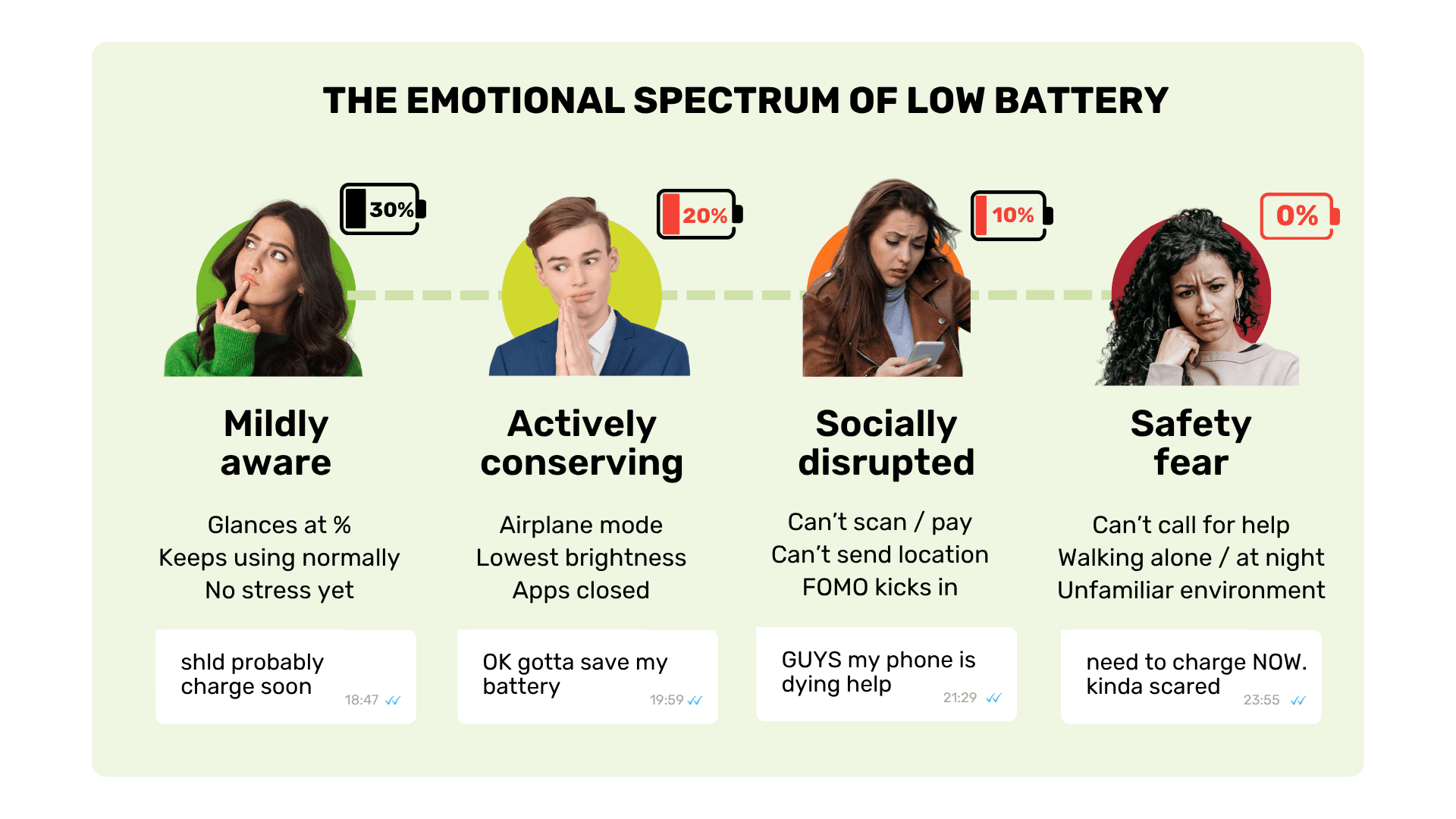
What is particularly interesting is that this anxiety is not constant. Most respondents manage their battery levels without much concern during everyday routines. The problem emerges in specific moments: nights out, festivals, travel, unfamiliar environments or just when plans run longer than expected.
But battery anxiety is not experienced equally. When we broke the data down by gender, a much sharper pattern emerged.
59% of women reported feeling unsafe or anxious when their battery ran out, compared with 32% of men.
Women also tend to start feeling anxious at higher battery levels and are more likely to describe low battery as a serious safety problem.
"When my phone dies and I need to go past those homeless people, I'm really scared — I could not call someone, or they don't have my location anymore." — Josephine, 22
For many women, the phone serves as more than a communication tool. It provides access to location sharing, navigation, emergency contact, and the ability to call for help if needed. Losing battery means losing access to those layers of reassurance and control.
For men, the emotional weight is generally lower. The framing is more practical: losing navigation, losing payments, losing coordination.
The same problem exists for both groups, but the meaning attached to it is often very different.
If low battery is such a meaningful problem, the obvious question is:
Why aren't existing solutions solving it?
The powerbank paradox
The answer turned out to be surprisingly simple. 83% of Dutch Gen Z own a powerbank.
At first glance, that might suggest the problem is already solved. But the reality is more complicated.
28% rarely or never bring their powerbank with them.
The reasons are familiar:
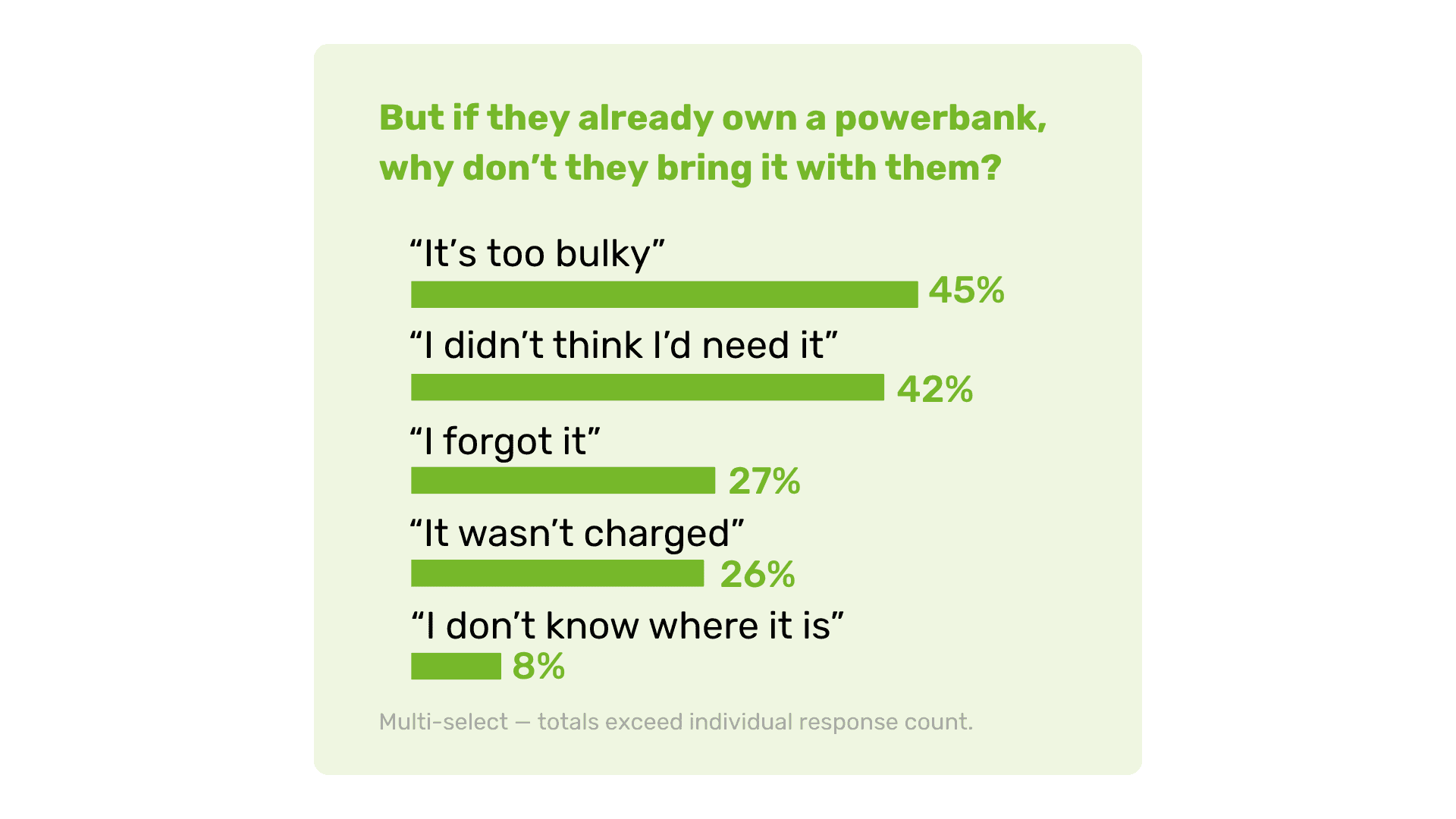
The research revealed an important distinction between ownership and availability. The solution already exists. It simply is not always available when it becomes necessary.
Interestingly, owning a powerbank does not significantly reduce interest in rental services. Respondents who already own one are almost just as likely to use a rental option as those who do not. This suggests that ownership and rental fulfil different needs. One is a planned solution. The other solves an unexpected problem when plans change.
The need appears in the moment
This creates an interesting paradox. Most Dutch Gen Z already own a solution to the problem. Yet when we asked about rental services, interest remained remarkably high.
55% of Dutch Gen Z say they would use a powerbank rental service if it were available nearby.
To put that figure into context, 48% of respondents reported buying Red Bull in convenience stores, while 40% reported buying Coca-Cola.
While stated intent and actual purchase behaviour are not directly comparable, the level of openness suggests that powerbank rental is far from a niche concept.
Only 4% of respondents say they definitely would not use such a service.
What matters most, however, is the nature of the demand.
Gen Z rarely plans to rent a powerbank.
The need appears suddenly.
A night out lasts longer than expected. A train journey is delayed. A festival still has hours to go. The battery drops into single digits.
The most common trigger, cited by 39% of respondents, was simple:
"Last resort. No other option."
This helps explain why visibility and accessibility matter so much. These are rarely planned purchases. They are decisions made in moments of immediate need.
Which raises the next question: If the need exists, where do young consumers expect to find a solution?
Where they want to find solutions
When we asked respondents where they would most like to pick up a rental powerbank, one retailer consistently appeared at the top.
Albert Heijn To Go.
It emerged as the preferred convenience store, preferred rental pickup location, and top coffee destination.
What makes this finding interesting is not simply which retailer came first. It is what the result reveals about Gen Z behaviour more broadly.
The retailers that perform best are often those already embedded into existing routines — commuting, travelling, grabbing a coffee, or making a quick stop between activities.
For many young consumers, loyalty appears to be a by-product of convenience. The retailers they visit most are often the ones already built into their daily routines.
Two types of customer walk through your door
Not all Gen Z consumers experience these moments equally often.
When we looked more closely at behaviour patterns, two distinct customer groups emerged.
Our analysis identified two distinct Gen Z customer segments.
The first is the Engaged Daily User. This person spends significant time moving around cities, is out multiple times a week, visits convenience stores frequently, and experiences battery-related problems more often simply because they are out and about more regularly.
The second is the Casual Visitor. They encounter the same challenges, but less frequently. Their interaction with the problem tends to be driven by specific occasions such as festivals, travel, or nights out.
Interestingly, the difference between these groups is not battery anxiety itself. Both begin feeling concerned at similar battery levels.
The difference is exposure. One group lives closer to the problem than the other.
The night-out profile is the highest-value moment
Among 17–25 year olds, one behavioural pattern stood out particularly clearly.
When purchasing alcohol in convenience stores, this group also purchased phone accessories at nearly five times the rate of older respondents.
In other words, they are already spending money to solve battery-related problems while they are out.
This suggests that keeping a phone alive during a night out is not a passive concern. It is an active behaviour. The phone remains central to coordination, communication, payments, transport, and social plans throughout the evening.
The more mobile the situation becomes, the more important that connection tends to be.
What this means
Across every finding in the study, the message is this: the phone has become infrastructure.
The Dutch Gen Z consumer is mobile, connected, and increasingly dependent on a single device for many of the functions that make everyday life work.
The most important finding from this research is not that young people spend a lot of time on their phones. We already knew that. The more interesting insight is that the smartphone has become infrastructure.
And when infrastructure fails, people look for solutions because, in that moment, they need them.
For retailers, the opportunity lies less in creating demand and more in understanding where those moments occur. Because the brands and services that become part of Gen Z's routine are often the ones that are already there when they are needed.
Want to get the full whitepaper? Download it here. [https://heychimpy.com/fr/gen-z-netherlands]
This article draws on Chimpy's Netherlands research conducted in early 2026: qualitative interviews (n=11) and a quantitative online survey (n=392) with Gen Z consumers aged 17–30 across Dutch cities.